
Castellano · Català · English
Buenos Aires pizza is not a badly copied Neapolitan pizza. It is a different thing, with a different origin and a different family tree, and clearing that up is what this page is for.
La Boca was Genoese, not Neapolitan
Pizza reached Buenos Aires in the second half of the nineteenth century with Italian immigration, and its first home was La Boca: a port neighbourhood of tenements and bakeries whose ovens ran through the night. But the Italians who filled that neighbourhood were not from Naples. They came mostly from Liguria, from Genoa and the towns around it.
That explains almost everything. What those immigrants carried in their luggage was not Neapolitan pizza but fugassa: Genoese focaccia, a flat bread with onion and olive oil that Ligurians eat at any hour, even with coffee. In Buenos Aires that dough met a different oven, a different cheese and a different crowd, and turned into something else.
Fugazza means focaccia
The word gives it away. Fugazza is the Spanish spelling of fugassa, which is Genoese for focaccia. It is not marketing and it is not a corruption: it is the same word crossing the Atlantic and losing a letter on the way.
So the fugazza is the oldest of them all: dough, onion, oregano and oil, with no tomato. Add cheese on top and you get fugazza con queso. Put that cheese between two layers of dough and the fugazzetta is born, which exists nowhere in Italy. It is Argentinian by birth.
The Banchero family
Tradition puts a name to that moment. In 1893 Agustín Banchero, from Genoa, settled in La Boca and opened a bakery, and there, with his son Juan, they began selling pizza. Juan Banchero is credited with inventing both fugazza con queso and the fugazzetta. In 1932 the family opened the Banchero pizzeria, and in 1934 the República de La Boca, the neighbourhood’s artists’ association, named him Emperor of the Fugazza with Cheese.
It is worth saying carefully: there is no birth certificate. It is an attribution held up by neighbourhood memory and decades of retelling, as happens with almost every popular dish. What is beyond dispute is the setting: a Genoese bakery, in La Boca, at the turn of the century.
Why our sign says «tradición desde 1932»
1932 is the year the Banchero family opened their pizzeria and the fugazzetta stopped being a bakery curiosity and became a habit. It is not the date someone first cooked it, which happened earlier and in a back room: it is the date it went public and started being repeated across the city.
The same thing happens with Argentinian rock and the song «La balsa». It was not the first, but it was the one that turned the whole thing into a phenomenon, so everyone tells the story from there.
To be clear: Pichuco opened in 2025. What begins in 1932 is not this house, it is the way of doing things we are trying to carry on.
Why baked in a pan
Here is the technical heart of it, and it is pure immigrant pragmatism. There were no pizza ovens in Buenos Aires. There were bread ovens, and bread pans. So pizza was made with what was there: a very wet dough, a long ferment, a greased pan and a bakery oven at moderate heat. That is where the tall, airy crumb comes from, and that is also why the first Buenos Aires pizzas were rectangular, like the bread pans. Round pans came later, to look more like the Italian ones.
Thin, stone-baked pizza, the one closer to the Italian original, did not become popular in Buenos Aires until the nineteen-seventies, almost a century later. The thin one is the newcomer, not the other way round.
And the cheese
The other difference is the pantry. Argentina was and is a dairy country, and that allowed a generosity with cheese that never made sense in Italy. Cuartirolo came first; later came a Buenos Aires mozzarella, different from the Italian one, stretchier and better suited to melting in quantity. Without that dairy industry the fugazzetta would not exist: you cannot invent a pizza with nine hundred grams of cheese somewhere cheese is expensive.
Fainá came off the same boat
Fainá is Genoese farinata, first cousin to the socca of Nice: chickpea flour, water, oil and pepper, baked in a pan. It arrived with the same immigrants and was sold in La Boca from the mid-nineteenth century, in the same bakeries that made the fugassa that would become pizza.
That is why pizza and fainá are sold together and eaten together, one on top of the other, in what Argentinians call «pizza a caballo», pizza on horseback. It is not a pizzeria gimmick: they were born in the same oven, from the same people, for the same customers.
The standing pizzerias
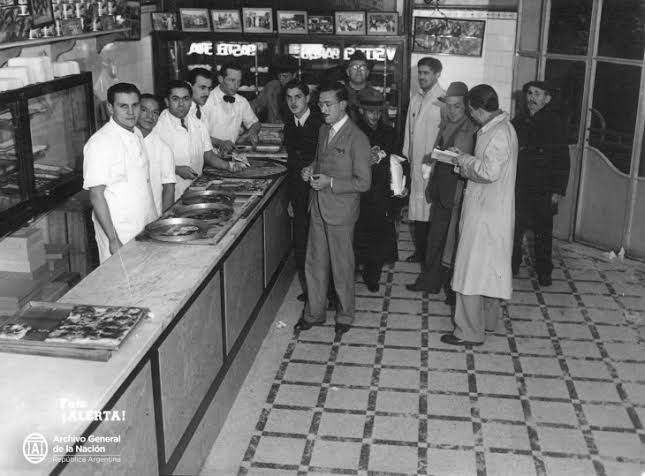
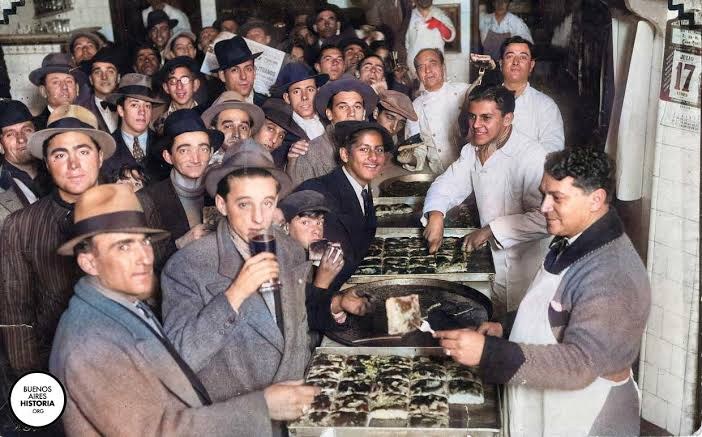
In the nineteen-thirties pizza stopped being street food and moved into rooms that became the meeting place of working-class Buenos Aires. Many of those houses are still open and still doing exactly what they did on day one. One is La Mezzetta, open since 1939 in Villa Ortúzar, where you eat standing up, there are no tables and the menu has four varieties. Its fugazzetta is the one I dreamt about one night, and the reason this pizzeria exists.
What this has to do with Pichuco
That when someone walks in here and sees a crust three fingers thick, a mountain of cheese and a slice of fainá on top, they are not looking at an adulterated Italian pizza. They are looking at the end of a road that started in Genoa, went through a bakery in La Boca and has been made this way for more than a hundred years.
We did not invent any of it. We are trying to do it well.